
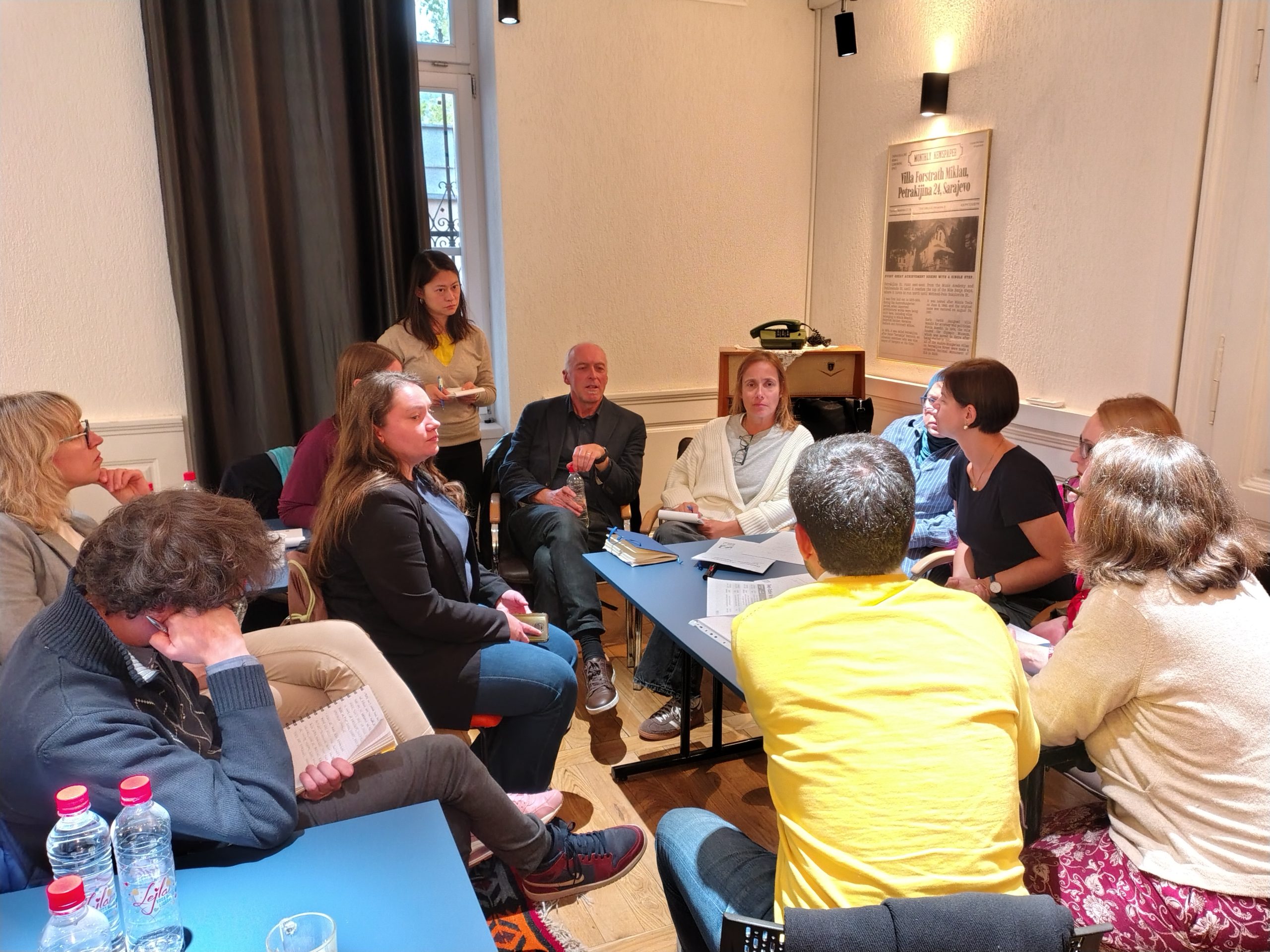
How can cities encourage people to change their travel habits, engage different target groups and make sustainable mobility measures work in practice? These questions were at the centre of the Shift2Sustain Advisory Board workshop, where representatives from seven pilot cities exchanged experiences and explored solutions with Advisory Board members Andrew Page – Future Mobility Lead at Transport for West Midlands in England – and Roelof Hellemans – Secretary General of the Mobility Alliance.
The session featured interactive challenge clinics addressing four key topics: engaging the recipients of mobility management measures, raising awareness of new transport services, enabling students to travel safely and independently to school and encouraging sustainable travel during major events.
Understanding people to drive behavioural change
In the first challenge clinic, Andrew Page discussed engagement strategies with representatives from Oeiras, Sarajevo, Turin and Gdansk. Each city faced a different challenge, from increasing survey response rates among business park employees and students to reaching older people and encouraging habitual car users to consider alternatives.
The discussion highlighted the importance of adapting engagement methods to the target audience. Suggestions included strengthening cooperation with employers, setting up information stands in business parks, introducing referral schemes and competitions, and offering incentives to encourage participation. For older residents, more traditional approaches, such as printed surveys, leaflets and outreach in familiar community venues, could help improve engagement.
The exchange also explored how incentives could support more significant behavioural changes. Turin, for example, raised the challenge of how to encourage public transport use or active mobility for those who use private cars. One proposal was to explore incentives for giving up older vehicles, with the resulting transport credit used for alternatives such as bike-sharing or taxi journeys.
A common message emerged: cities need to understand the people they want to reach, their motivations and their everyday needs before designing measures intended to change their behaviour.
Making independent school travel possible
The second challenge clinic brought together Andrew Page and representatives from Copenhagen, Izmir and Oeiras to discuss how students could travel safely and independently to and from school.
Participants emphasised that infrastructure, parental perceptions and local culture all influence children’s travel choices. While safe routes and suitable infrastructure are essential, cities also need to build trust among parents and communities.
Copenhagen suggested developing safe corridors leading to designated zones around schools, allowing parents to accompany children part of the way without driving them directly to the school gates. Other ideas included improving pedestrian crossing safety, promoting school buses as an alternative to individual car journeys and exploring incentives that appeal to older students.
Andrew Page encouraged cities to engage directly with parents to understand their concerns and identify the barriers preventing children from travelling independently. This feedback can help cities design measures that respond to real needs rather than assumptions.
Raising awareness of new mobility services
In a challenge clinic with representatives from Copenhagen, Zagreb and Izmir, Roelof Hellemans explored why some mobility services fail to attract users and how cities can encourage citizens to integrate new options into their everyday travel habits.
A key takeaway was the need to start with people, rather than the service itself. Cities should understand who their current and future users are, what their mobility needs are and how these may evolve over the next decade. Involving citizens and the right stakeholders from the outset can help ensure that measures respond to real needs and support behavioural change.
The discussion also highlighted the importance of making sustainable alternatives easy to use. Different target groups respond to different incentives and reducing barriers to access can be more effective than relying on incentives alone. Offering several transport options as part of a wider mobility system can help citizens find solutions that suit their circumstances.
Communication plays an equally important role. Cities need to use the right channels for different audiences, including trusted voices and influencers to reach younger people. Demonstrating what has been implemented, how public money has been spent and what impact measures have achieved can help build trust and encourage uptake.
Encouraging sustainable travel during major events
Roelof Hellemans also worked with representatives from Gdansk, Turin, Sarajevo and Zagreb to explore how cities can encourage sustainable travel during major events.
The discussion highlighted the importance of integrating mobility planning into event organisation from the outset. Measures such as road closures, additional public transport services, free bike-sharing and improved walking access can help reduce pressure on parking and encourage alternatives to private cars. However, these measures must be carefully planned to ensure safety and maintain access for emergency and other essential services.
Understanding how people make travel decisions is equally important. Cities and event organisers need to identify their target audiences, ask how attendees plan to reach an event and understand what would encourage them to choose sustainable alternatives. Rather than simply promoting transport options, communication should highlight tangible benefits such as convenience, comfort, punctuality and less stressful journeys.
Timing is another key consideration. Information about road closures and alternative transport options should reach people when they are making decisions about attending the event and arranging their journey. Ticket booking, for example, can provide an early opportunity to communicate available options and encourage people to plan ahead.
Finally, participants discussed the importance of clarifying responsibilities between event organisers and public authorities. Identifying who leads mobility planning, who benefits financially from the event and how revenues, such as parking fees, could support alternative transport measures can help ensure that sustainable mobility is considered an integral part of event management.
Turning insights into action
The Advisory Board workshop reinforced a central principle of Shift2Sustain: successful mobility management depends on more than designing the right measure. It requires understanding people’s needs, involving relevant stakeholders, communicating benefits clearly and making sustainable choices practical and attractive.
For the project’s seven pilot cities — Copenhagen, Gdansk, Izmir, Oeiras, Sarajevo, Turin and Zagreb — the challenge clinics provided an opportunity to exchange experiences, learn from different approaches and identify practical ways to support lasting behavioural change.
Published on 6 November, 2026.

